Every HR manager knows the feeling.
Monday morning. Attendance registers to verify. Late marks to calculate. Half days to adjust. Shift changes to update. Leave balances to cross check. And payroll waiting on all of it.
This isn't HR work. This is data entry. And it's eating your most productive hours every single month.
The good news? Modern HRMS software has completely changed how attendance works — turning what used to take days into something that runs automatically in the background while your HR team focuses on actual people work.
Why Manual Attendance Management Fails Growing Businesses
Most businesses start with a simple attendance system — a register, a biometric machine, or a basic Excel sheet. It works when you have 10 people. It breaks when you have 50.
Here's what goes wrong as businesses grow:
Multiple shift patterns — morning, afternoon, night, rotational — each with different rules for late marks, overtime, and breaks. Managing this manually across dozens of employees is a recipe for errors.
Inconsistent policy application — when attendance is tracked manually, rules get applied differently for different employees. This creates perception of favouritism and erodes trust.
Payroll dependency — every payroll error traces back to an attendance error. Wrong attendance data means wrong salary — and nothing damages employee trust faster than a wrong paycheck.
Compliance gaps — labour laws in India require accurate attendance records for PF, ESI, gratuity and other statutory calculations. Manual records rarely hold up during audits.
A mid-sized logistics company in Pune once spent 4 full working days every month reconciling attendance data across three locations before payroll could be processed. After implementing Pletox HRMS, that process came down to a few hours — with zero manual reconciliation.
What Attendance Policy Automation Actually Means
Attendance policy automation isn't just about replacing a register with a biometric device.
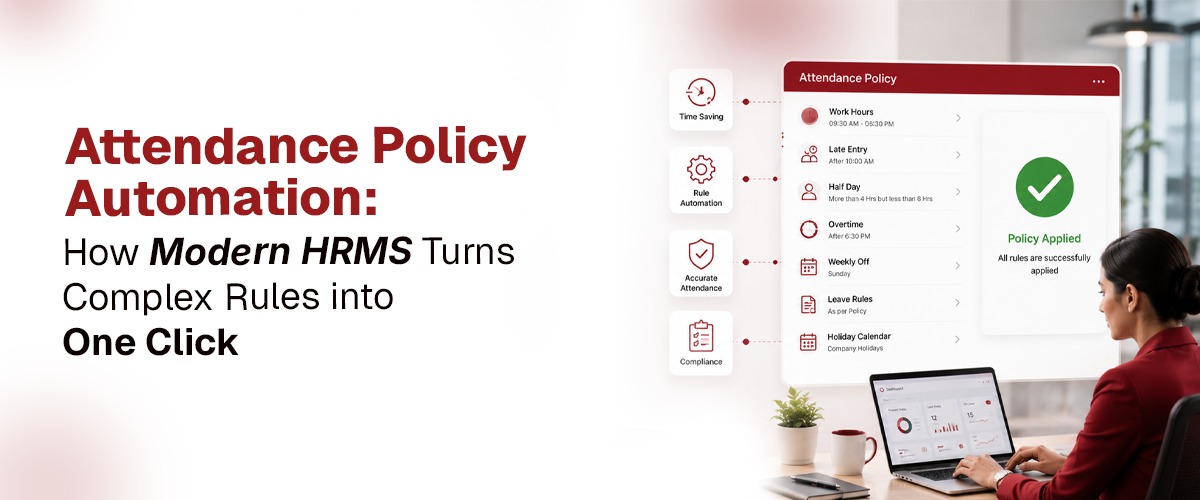
It means your entire attendance framework — every rule, every exception, every policy — is built into the system once, and then runs automatically every single day without human intervention.
This includes:
Shift management — define multiple shift patterns, assign employees to shifts, handle rotational schedules and swap requests — all without manual coordination.
Late mark and early exit rules — set grace periods, define how late marks are calculated, decide when a half day triggers versus a full day absence — the system applies these consistently for everyone.
Overtime calculation — define overtime thresholds and rates, and let the system calculate automatically based on actual clock-in and clock-out data.
Leave integration — when an employee applies for leave, the attendance system updates automatically. Approved leaves don't show as absences. Unapproved absences are flagged immediately.
Holiday and week-off management — set national holidays, company holidays, and week-off patterns once. The system handles them automatically across all payroll calculations.
Regularisation workflows — when an employee misses a punch or needs to regularise attendance, they raise a request through the system, their manager approves or rejects it, and the record updates — no emails, no WhatsApp messages, no paper forms.
How Pletox Handles Attendance Policy Automation
Pletox HRMS is built specifically for businesses that have outgrown manual attendance management — whether that's a 30-person startup or a 500-person manufacturing unit.
Flexible Shift Configuration
Most HRMS tools handle simple 9-to-5 schedules. Pletox is built for the complexity of real Indian businesses — with support for fixed shifts, rotational shifts, flexible work hours, and field-based attendance.
Pletox's Time and Attendance module lets HR teams define shift rules once and assign them to individuals, teams, or departments — with automatic updates when assignments change.
Biometric and Mobile Attendance
Pletox supports multiple attendance capture methods — biometric devices, mobile check-in with GPS location verification, and the Pletox Self-Service Kiosk for contactless face-recognition based punch-in.
For field teams and remote employees, mobile attendance with live location tracking ensures accurate records without requiring physical presence at a central location.
Automatic Payroll Integration
This is where attendance automation delivers its biggest value.
When attendance data flows directly into Pletox Payroll — every late mark, leave deduction, overtime calculation and loss of pay is computed automatically. HR doesn't manually transfer data between systems. Finance doesn't wait for HR to send a spreadsheet. Payroll just runs — accurately, on time, every month.
Real-Time Dashboards and Reports
Instead of waiting until month-end to know who was absent, who was late, or which department has an attendance problem — Pletox gives managers and HR teams real-time visibility through dashboards that update automatically throughout the day.
The Business Impact of Automating Attendance
The benefits of attendance policy automation go beyond saving HR time — though that alone is significant.
Payroll accuracy improves dramatically — when attendance feeds automatically into payroll, the most common source of salary errors disappears. Employees are paid correctly, on time, every time.
Compliance becomes straightforward — accurate, system-generated attendance records satisfy audit requirements for PF, ESI and labour law compliance without any additional effort from HR teams.
Employee trust increases — when attendance rules are applied consistently and transparently — the same rules for everyone, visible in the employee's own self-service portal — disputes reduce and trust improves.
HR teams reclaim their time — the hours previously spent on attendance reconciliation, leave calculations and payroll preparation get redirected to hiring, employee engagement and culture building — the work that actually requires human judgment.
Who Needs Attendance Policy Automation?
Manufacturing companies — with complex shift patterns, multiple plants, and large workforces, manual attendance management is simply not scalable. Pletox's manufacturing-ready HRMS handles multi-location, multi-shift attendance automatically.
Retail and hospitality businesses — with variable schedules, weekend working, and high staff turnover, automated attendance is essential for accurate payroll and compliance.
Field-based businesses — sales teams, service teams, and delivery operations need mobile attendance with location verification — not office-based biometric systems.
Any business with 20+ employees — once a company crosses 20 employees, manual attendance management starts creating problems. Automation at this stage prevents those problems from compounding as the business grows.
FAQs:
Q: What is attendance policy automation in HRMS?
Attendance policy automation means your company's attendance rules — shifts, late marks, overtime, leave deductions, holidays — are configured in the HRMS once and applied automatically every day without manual intervention. Modern HRMS platforms like Pletox handle the full complexity of Indian business attendance requirements in one system.
Q: How does HRMS attendance automation connect to payroll?
When attendance data is captured automatically and stored in the same system as payroll, salary calculations happen automatically based on actual attendance records. Pletox Payroll pulls directly from attendance data — eliminating manual data transfer and the errors that come with it.
Q: Can HRMS handle multiple shifts and complex attendance policies?
Yes. Pletox HRMS supports fixed shifts, rotational shifts, flexible hours, and field-based attendance — with different rules for different employee groups, all managed from one platform.
Q: Is mobile attendance tracking reliable for field employees?
Modern HRMS platforms like Pletox use GPS-verified mobile check-in, ensuring that field employees can mark attendance from their location while HR has full visibility of where and when they checked in. This is far more reliable than paper-based field attendance records.
Q: How long does it take to set up attendance automation in Pletox?
Most businesses are fully set up and running on Pletox's attendance module within a few days. The configuration is designed to be handled by HR teams directly — without needing technical expertise or extended implementation timelines.
Final Thought:
Attendance management is one of those HR functions that feels simple until it isn't.
One company, one shift, ten employees — easy. Three locations, five shift patterns, 200 employees, variable overtime rules, and a payroll deadline every month — that's where manual systems break down.
Automation doesn't just save time. It eliminates an entire category of error that quietly costs businesses money, employee trust, and HR team morale every single month.
The right HRMS doesn't make attendance management easier. It makes it invisible — running correctly in the background while your HR team focuses on work that actually matters.
Ready to automate your attendance policy and eliminate manual HR work? Explore Pletox HRMS or book a free demo to see how attendance automation works for your business.