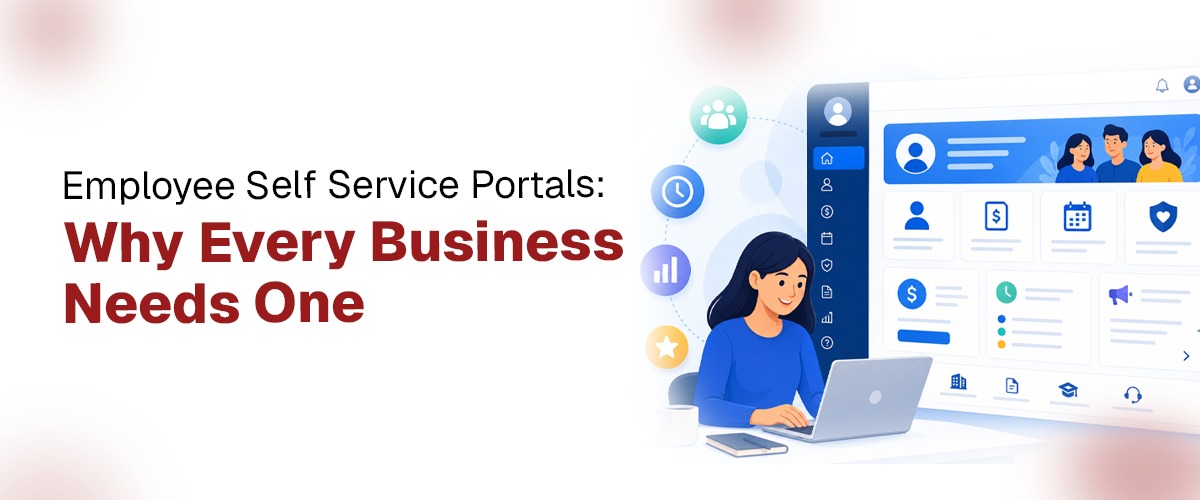
Employee Self Service Portals: Why Every Business Needs One
A new employee needs their payslip. They email HR. HR is in a meeting. The employee waits two days for a response.
This happens in thousands of companies, every single day. Not because HR doesn't care — but because there's no system that lets employees help themselves.
That's exactly the gap an Employee Self Service Portal fills.
What is an Employee Self Service Portal?
It's a simple platform where employees can access their own information and complete routine HR tasks — without needing to go through HR for every small request.
Through a self-service portal, employees can typically:
- View and download payslips
- Apply for and track leave requests
- Update personal details
- Check attendance records
- Access company policies and documents
- View tax declarations and reimbursement status
Instead of emails, phone calls, and follow-ups — employees get instant access to what they need.
Why This Matters More Than Most Companies Realise
It Saves HR Teams Enormous Time
Think about how many hours HR spends every month answering the same repetitive questions — "What's my leave balance?" "Can I get last month's payslip?" "Has my address update gone through?"
A self-service portal answers these instantly — without a single email exchange. This frees up HR teams to focus on work that actually requires human judgment — hiring, employee relations, culture building.
Pletox HRMS gives employees instant access to their payslips, attendance records, and leave balances — without a single email to HR.
Real example: An HR manager at a 150-employee logistics company once tracked how much time her team spent on payslip requests alone — nearly 6 hours a week, across the team. After introducing self-service access, that time dropped to almost zero.
It Improves Employee Experience
Employees today expect the same convenience at work that they get everywhere else — instant access, no waiting, no chasing people down.
When an employee can check their leave balance in 10 seconds instead of waiting two days for a reply, it sends a quiet but powerful message: this company respects my time.
Small things like this add up to a much better overall employee experience.
It Reduces Errors
When employees update their own personal details — address, bank account, emergency contacts — directly into the system, there's no manual data entry by HR. That means fewer typos, fewer outdated records, and fewer payroll errors caused by incorrect information.
It Builds Transparency
When employees can see their own attendance, leave balance, and salary structure clearly — there's less room for confusion or disputes. Transparency builds trust, and trust is something most workplaces struggle to maintain without it.
Common Concerns — Addressed
"Won't this make HR feel impersonal?"
Not really. Self-service handles the repetitive, transactional tasks. It actually frees up HR to spend more time on meaningful, personal interactions — career conversations, conflict resolution, employee wellbeing — instead of administrative back and forth.
"What if employees misuse it or make mistakes?"
Most platforms include approval workflows. An employee might request a leave change, but a manager or HR still approves it. Self-service doesn't mean no oversight — it means less manual work for routine actions.
"Is this only useful for large companies?"
Not at all. Even a 20-person company benefits — fewer interruptions for HR, faster answers for employees, and a more professional, organised feel to HR operations overall.
What Good Implementation Looks Like
A well-implemented self-service portal isn't just about having the feature — it's about making it genuinely usable.
That means:
- Simple, intuitive interface — employees shouldn't need training to use it
- Mobile access — many employees, especially field staff, need this on their phones
- Clear approval workflows — so requests don't disappear into a black hole
- Proper data security — personal and salary information needs to be protected
Companies that get this right see real adoption. Companies that roll out a clunky, confusing system often find employees going back to emailing HR anyway — defeating the entire purpose.
FAQs
Q: What's the biggest benefit of an employee self-service portal?
Time saved — for both HR and employees. Routine requests that used to take days now take seconds, freeing HR to focus on higher-value work.
Q: Do employees actually use these portals, or do they still prefer emailing HR?
Adoption depends heavily on usability. If the portal is simple and mobile-friendly, employees use it readily — often preferring it to waiting for a human response.
Q: Is self-service portal data secure?
It should be. Look for platforms with role-based access control, data encryption, and clear data privacy practices, especially since salary and personal information is involved.
Q: Can small businesses benefit from self-service portals?
Modern HRMS platforms like Pletox now offer self-service as a built-in feature, making it accessible even for smaller teams without a separate software investment.
Final Thought
Employee self-service portals aren't about replacing HR — they're about removing the repetitive, low-value tasks that eat up HR's time so the human side of HR can actually happen.
Employees get faster answers. HR gets their time back. Everyone wins.
In a workplace where speed and convenience matter more than ever, this is one of the simplest upgrades a company can make.
Ready to give your employees instant access and free up your HR team's time? Explore Pletox HRMS — built for teams of every size.