The Hidden Cost of NOT Having an ERP in Manufacturing
Most manufacturing businesses only think about ERP software when things go visibly wrong — a missed delivery, a stock-out, a costly production error. But the real cost of not having an ERP system isn't always visible on a balance sheet. It quietly eats into your margins every single day, through delays, miscommunication, and manual errors that never get tracked back to their real cause.
If you're running a manufacturing business on spreadsheets, notebooks, or disconnected software for each department, this article breaks down exactly what that's costing you — and why more manufacturers are moving to a manufacturing ERP solution built for their industry.
1. Wasted Raw Material — The Cost You Never See on Paper
Without real-time inventory tracking, manufacturers routinely over-order or under-order raw materials. Excess stock ties up cash and risks spoilage or obsolescence. Understocking causes production delays while waiting for emergency orders — often at a higher price than planned.
An ERP system with live inventory management tracks raw material usage against your Bill of Materials (BOM) automatically, so you always know exactly what you have, what's needed, and when to reorder — no guesswork, no last-minute panic-buying.
2. Production Delays from Poor Scheduling
Without a centralized production planning module, scheduling is often done manually — on whiteboards, in someone's head, or across disconnected spreadsheets. This leads to double-booked machines, idle workers waiting on materials, and missed delivery deadlines.
A proper production planning module automatically balances machine availability, workforce shifts, and material readiness — preventing the kind of scheduling chaos that quietly costs manufacturers days of lost output every month.
3. Manual Errors That Compound Down the Line
When departments use separate systems (or spreadsheets) that don't talk to each other, human error creeps in constantly — a wrong quantity typed into an order, a stock count that doesn't match reality, an invoice that doesn't reflect the actual delivery.
These aren't one-time mistakes. Because manufacturing is a chain — sales feeds inventory, inventory feeds production, production feeds accounting — a single manual error early in the chain multiplies as it moves downstream. An ERP eliminates this by making one action (like confirming a sales order) automatically and accurately update every connected module.
4. Poor Visibility Means Poor Decisions
Without an ERP, business owners and managers often don't know their real profit margins, production costs, or bottlenecks until month-end — if at all. Decisions get made on gut feeling instead of real data.
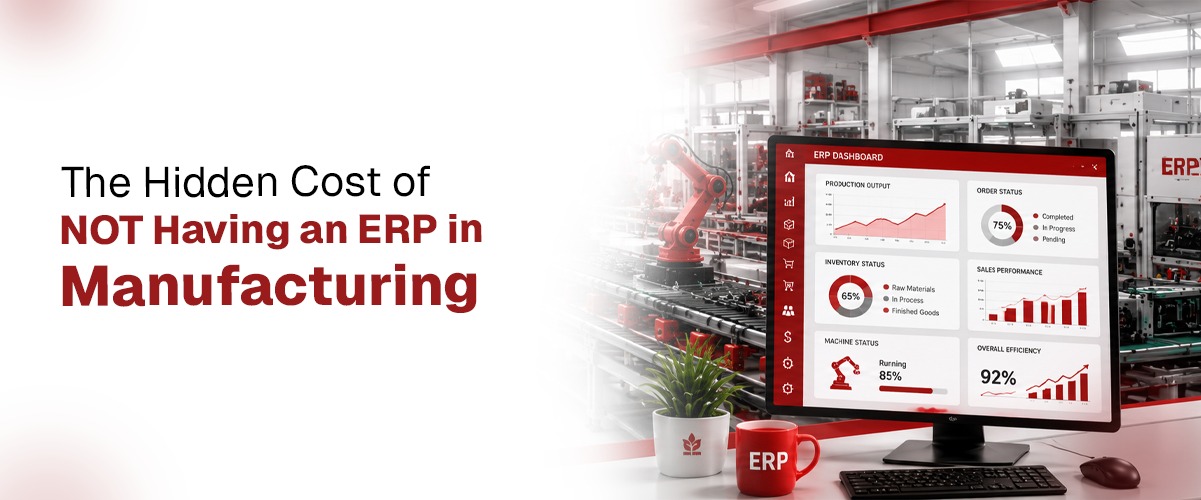
With built-in reporting and dashboards, ERP software gives manufacturers real-time visibility into costs, production efficiency, and profitability — enabling faster, more confident decisions instead of reactive firefighting.
5. Compliance Risks and Audit Headaches
Manufacturing businesses often need to meet tax regulations, labor law compliance, and quality standards. Manually maintaining audit trails, TDS calculations, and statutory compliance records is time-consuming and error-prone — and a compliance slip can mean penalties or failed audits.
ERP systems with built-in compliance and finance modules automate tax calculations, maintain audit trails, and keep statutory records organized — reducing both the workload and the risk.
6. Customer Trust Erodes Quietly
Late deliveries, incorrect orders, and inconsistent quality — all common symptoms of poor internal coordination — don't just cost you money on the specific order. They cost you the customer's trust, and eventually, their repeat business. In a competitive manufacturing market, that's often the most expensive hidden cost of all.
The Real Question Isn't "Can We Afford an ERP?" — It's "Can We Afford Not To?"
Many manufacturers delay ERP adoption because of the upfront cost or the fear of a complicated implementation. But as this breakdown shows, the cost of staying without one is ongoing, compounding, and often invisible until it's already hurt the business.
A customizable, manufacturing-focused ERP like Pletox is built specifically to address these pain points — without the complexity and cost of enterprise systems like SAP, and with the deep manufacturing capability that general-purpose tools like Zoho often lack.
FAQs
1. What is the hidden cost of not using an ERP in manufacturing?
The hidden costs include wasted raw material, production delays from poor scheduling, manual data-entry errors, poor visibility into real profitability, compliance risks, and long-term loss of customer trust due to delivery or quality issues. A manufacturing ERP solution addresses all of these in one connected system.
2. Is ERP only necessary for large manufacturing companies?
No. Small and mid-sized manufacturers often lose a higher percentage of their margins to inefficiency simply because they don't have the manual workforce large companies use to catch errors. Custom ERP implementation is often more critical for smaller manufacturers, not less.
3. How does ERP reduce raw material wastage?
ERP systems track raw material usage in real time against the Bill of Materials (BOM) for each product, automatically updating stock levels and flagging reorder points — preventing both overstocking and last-minute shortages.
4. Can ERP help with compliance in manufacturing?
Yes. Most manufacturing ERP systems include built-in tax calculation, audit trail tracking, and statutory compliance features as part of their finance and ERP modules, reducing the manual effort and risk involved in staying compliant.
5. How is a manufacturing-focused ERP different from a general ERP?
General-purpose ERPs (like Zoho) often lack deep manufacturing features such as Bill of Materials, production scheduling, and shop-floor tracking. Manufacturing-focused, customizable ERPs are built specifically to handle these processes in detail.
6. How long does it take to see ROI after implementing an ERP?
This varies by business size and complexity, but most manufacturers begin seeing measurable improvements in inventory accuracy and production efficiency within the first few months of proper implementation. You can track this improvement directly through real-time dashboards and reporting.
Looking to see how much inefficiency might be costing your manufacturing business? Get in touch with Pletox to explore a solution built for manufacturers.