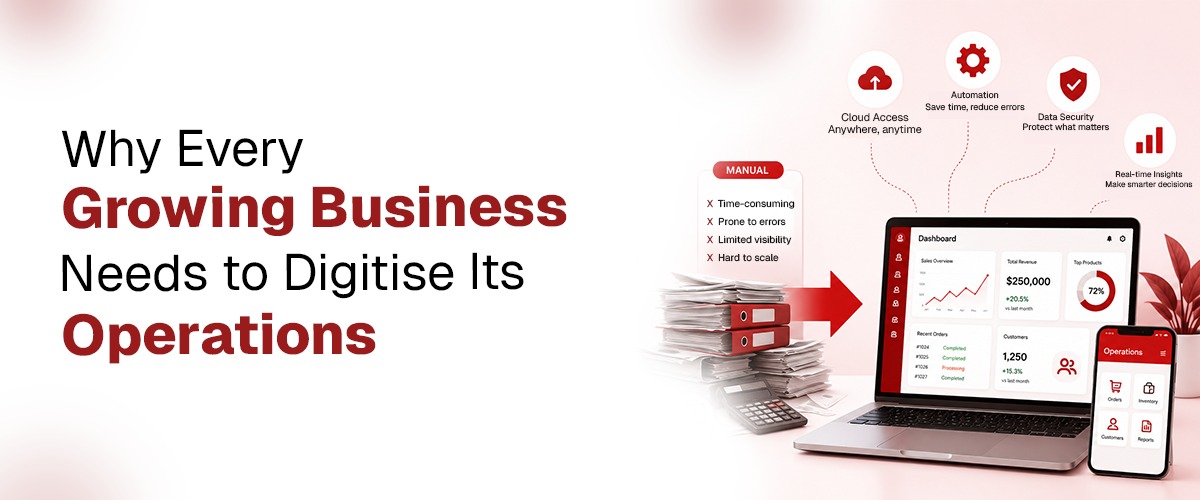
Why Every Growing Business Needs to Digitise Its Operations.
Every business starts the same way — a register here, a spreadsheet there, WhatsApp groups for everything else.
It works in the beginning. But as the business grows, the cracks start showing. Orders get missed. Customer follow-ups fall through. Payroll takes days. Reports take longer than the decisions they're supposed to support.
The problem isn't the people. It's the process.
And the solution isn't just any software — it's custom business software built around how your business actually works.
What Does "Digitising Your Business" Actually Mean?
Business digitisation isn't about buying the most expensive software or moving everything to the cloud overnight.
It means replacing manual, disconnected, error-prone processes with a connected digital system — one that works the way your business works, not the other way around.
For a retail shop, it might mean automating customer follow-ups and billing. For a manufacturing company, it could mean tracking field visits and inventory in real time. For a growing startup, it might mean bringing HR, payroll, and team management into one place.
The common thread? One system. Your workflow. Everything connected.
5 Clear Signs Your Business Needs to Digitise — Now
1. You're Managing Critical Information on WhatsApp and Excel
WhatsApp groups and Excel sheets are where most Indian businesses start. They're familiar, free, and flexible.
But they're not built for scale.
When your sales team is updating deals in a WhatsApp group, your HR is tracking attendance on a shared sheet, and your billing is done manually — you're not running a system. You're running on memory. And memory fails.
2. You Have No Real-Time Visibility
Can you tell right now — how many leads your sales team is following up on? Which employees are on leave today? What's your outstanding billing this month?
If the answer involves calling someone or opening three different files — your business doesn't have visibility. It has guesswork.
Real-time data isn't a luxury. For growing businesses, it's the difference between a good decision and an expensive mistake.
3. Your Team Is Wasting Hours on Repetitive Work
How much time does your HR team spend manually calculating attendance and payroll every month? How long does your sales team spend updating customer records?
These are not high-value tasks. They're repetitive, manual, and error-prone — and every hour spent on them is an hour not spent on growing the business.
A manufacturing company in Pune reduced their monthly payroll processing time from 3 days to 4 hours after moving to an integrated HR and payroll system. Nothing else changed — just the process.
4. Errors Are Costing You Money and Trust
Manual processes create manual errors. A wrong salary. A missed customer follow-up. An inventory count that doesn't match the actual stock.
Each error has a cost — sometimes financial, sometimes in trust. And in a growing business, errors compound faster than you'd expect.
5. Your Competitors Are Already Ahead
The businesses gaining ground in your market aren't necessarily smarter or better funded. Many of them are simply more organised — because they've built systems that let their teams focus on the work that actually matters.
Why Generic Software Often Fails Growing Businesses
Most off-the-shelf software is built for the average business. But your business isn't average — it has its own workflows, its own team structure, its own customer journey.
Generic software forces you to adapt to it. That means workarounds, unused features, and frustrated teams who find it easier to go back to WhatsApp.
The smarter approach is custom business software built around your specific business flow — so your team actually uses it, and it actually solves your problems.
At Pletox, this is exactly how we build. We don't offer a one-size-fits-all platform. We build software that fits how your business actually runs — whether that's HR and workforce management, CRM and sales tracking, payroll and compliance, or project and task management.
What Business Digitisation Actually Looks Like in Practice
For a Retail or Distribution Business
- Customer records managed in a CRM — not a register
- Automated follow-up reminders so no lead goes cold
- Real-time billing and inventory reports
For a Service or Consulting Business
- Team tasks and project timelines tracked in one place with Projects & Tasks
- Field visits logged automatically with location tracking
- Client communication history always accessible
For Any Business With a Team
- Attendance tracked automatically — no registers, no manual entry
- Payroll calculated from live attendance data — no errors, no delays
- Employee records, leave, and documents managed through HR software
The Real ROI of Digitising Your Business
The return on digitisation isn't just time saved — though that alone is significant.
It's the decisions you make better because you have accurate data. The customers you retain because your follow-up didn't slip through. The employees you keep because your HR processes are fair, transparent, and efficient.
Businesses that digitise their operations early don't just grow faster. They grow more sustainably — because their systems scale with them instead of breaking under the pressure.
FAQs :
Q: Is business digitisation only for large companies?
Not at all. In fact, small and mid-sized businesses in India benefit the most — because the gap between where they are (manual processes) and where they could be (automated, connected systems) is largest. Even a 20-person business can see dramatic improvements with the right software.
Q: How long does it take to digitise business operations?
It depends on the complexity of your business and the solution. Simple implementations can go live in days. More complex, customised systems take a few weeks. The key is starting — every month of delay is another month of manual errors and lost productivity.
Q: What's the difference between custom software and off-the-shelf software?
Off-the-shelf software is built for the average business — you adapt to it. Custom software is built around how your business actually works — it adapts to you. For growing businesses with specific workflows, custom software almost always delivers better adoption and better results.
Q: How does Pletox approach business digitisation?
Pletox builds software around your specific business flow — not the other way around. From HR and payroll to CRM, billing, and operations — we create connected systems that fit how your team works. Book a free demo to see how we can digitise your operations.
Final Thought :
The question isn't whether your business needs to digitise. It does.
The real question is whether you build a system that fits your business — or settle for one that makes your business fit the system.
Growing businesses that digitise their operations on their own terms — with software built around their actual workflow — don't just save time. They build a foundation that scales, adapts, and keeps them ahead.
Your business has its own way of working. Your software should too.
Ready to digitise your business operations with software built around your workflow? Explore Pletox or book a free demo today.